What Do October's Results Reveal About the September Surge?

This article is part of the monthly Job Market Reality Check series, where I analyze employment trends and translate labor market data into practical career strategies for professional women navigating today's evolving workplace.
Remember all that talk about the September Surge?
Every fall, we hear that hiring is about to pick up. Summer vacations are over, employers are getting back to business, and companies are looking to fill positions before the end of the year.
When I wrote October's Job Market Reality Check, the numbers weren't giving us much reason to celebrate. Hiring was happening, but there was little evidence of the surge we'd been anticipating.
Well, we have more information now.
September's employment figures have been revised, new data show that job postings picked up after Labor Day, and October delivered stronger job growth than we've seen in recent months.
So, did the September Surge actually happen?
There was a pickup in activity. Whether that translates into better opportunities for job seekers is a more complicated question…read on.
The September Surge: What We Know Now
Let's start with what we couldn't see when I wrote last month's article.
According to MORT, a company that tracks job postings directly from employer applicant-tracking systems, U.S. postings reached a 17-week high during September 14–21.
Its tracking data showed 53,348 new postings that week, up nearly 30% from the previous week and 16% above its June baseline.
That's so encouraging.
But the previous week included Labor Day, when posting activity typically slows. So some of that increase likely reflects employers returning to normal activity after the holiday.
And remember, a job posting isn't the same as someone actually getting hired.
We also have new information from the Bureau of Labor Statistics (BLS).
Its September Job Openings and Labor Turnover Survey (JOLTS), released November 3, reported:
7.5M job openings
5.4M hires
3.4M voluntary quits
Job openings and hires were largely unchanged from August, although voluntary quits increased.
That's an important difference. Employers were advertising positions, and people were changing jobs, but the data don't establish a significant nationwide increase in hiring during September.
So yes, there was evidence of a seasonal pickup in job-posting activity.
But the September Surge was more of a pickup than a hiring boom.
More Reason for Optimism
Now let's look at October.
The BLS Employment Situation report, issued on November 6th, showed that U.S. employers added 165K jobs in October.
That's a meaningful improvement over the month before.
Revisions to earlier reports show even more growth.
Remember September's initially reported gain of 29K jobs?
That number has now been revised upward to 60K.
August's employment growth was also revised upward, from 133K to 186K.
Combined, those revisions added another 84K jobs to the previously reported totals.
WOW!
This is why I continue to remind you that the first employment report is an estimate. As additional information becomes available, BLS revises its numbers.
The latest figures give us a somewhat stronger picture of late-summer and fall hiring than we had when we reviewed September's initial report.
Again…encouraging.
But before we declare that the job market has turned a corner, there's more to consider.
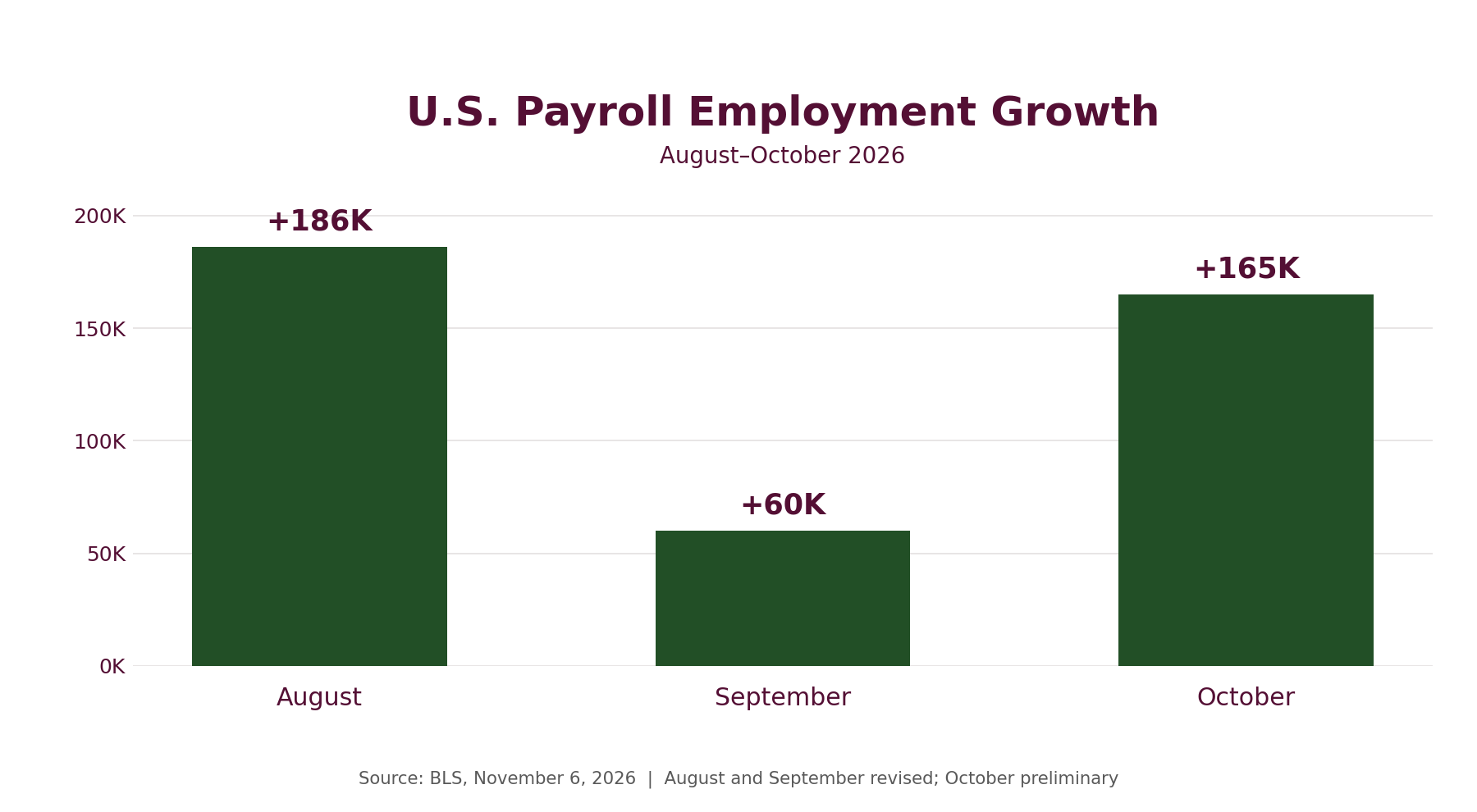
U.S. payroll employment gains, August–October 2026. August and September figures revised; October preliminary. Source: Bureau of Labor Statistics, November 6, 2026.
ADP + October Hiring
ADP's National Employment Report showed that private-sector employers added 86K jobs in October.
The largest increases occurred in:
Trade, transportation, and utilities: +39K
Education and health services: +28K
Leisure and hospitality: +19K
Professional and business services, however, lost 27K jobs, according to ADP.
Now here's where things get interesting.
BLS reported that professional and business services actually gained 70K jobs in October.
That's a significant difference.
Before you wonder which report is correct, remember that ADP and BLS collect and analyze employment information very differently.
ADP measures private-sector employment using payroll information from businesses in its dataset. BLS uses a broader survey of employers and includes government employment in its overall payroll figures.
The two reports also use different statistical methods.
Their industry estimates can differ substantially in a given month, and both are subject to revisions.
What does this mean for you?
If you're pursuing opportunities in business operations, consulting, human resources, marketing, or another professional field, don't assume that national job growth reflects what's happening in your particular occupation.
Look at the employers and industries where your experience is needed.
Fewer Layoffs
Challenger, Gray & Christmas released its October Job Cuts Report on November 5th.
Employers announced approximately 44K job cuts in October, down 71% from only a year ago, October 2025.
That's good news.
Challenger also reported that employers announced plans to hire nearly 444K+ workers during October.
At first glance, that sounds like an enormous hiring surge…
A substantial portion of those hiring plans involved temporary seasonal positions. Those roles included Amazon, which plans to hire 300K seasonal workers, and UPS, which announced another 100K.
These announcements also arrived later than usual.
According to Challenger, large seasonal hiring plans have historically been announced in September. This year, the two largest announcements came in October.
That helps explain why September may have appeared quieter than expected.
Another important note here: hiring announcements represent intentions, not completed hires. And seasonal positions don't always create permanent career opportunities.
For someone pursuing a long-term professional position, that’s a real career difference.
Hiring Is Improving.
Why Does the Job Search Still Feel So Difficult?
This is the question I keep coming back to.
We have stronger payroll growth, fewer announced layoffs, and millions of existing job openings.
Yet I continue to hear from professionals who are spending months looking for their next opportunity.
How can both things be true?
Because the job market isn't one giant hiring pool.
Opportunities vary by industry, occupation, location, experience level, and employer.
And even when companies have positions open, they aren't necessarily moving quickly to fill them.
The September JOLTS report showed 7.5M openings and 5.4M hires. Those numbers measure different things: openings are counted at the end of the month, while hires are measured throughout the month.
They aren't directly comparable as though every opening should have produced a hire during September.
But the report still illustrates the broader environment we've been discussing.
Employers are maintaining positions and hiring selectively.
The market continues to show characteristics of what's often called low-hire, low-fire.
That creates different experiences depending on where you are in your career.
If you're employed, you may have some stability but limited opportunities for advancement.
If you're unemployed, the search may take longer than you anticipated.
And if you're considering a career move, you may be weighing the security of your current position against the possibility of something new or better.
And none of those situations can be explained by one national employment number. These are unique to you and your lived career experiences.
What This Means for Your Career
With the latest employment reports showing improvement, I see real reasons to be encouraged.
But I'd also encourage you to be thoughtful about how you respond.
Look Beyond the Employers You Already Know
Your next opportunity may be with an organization that hasn't been on your radar. Pay attention to companies expanding operations, investing in new services, or hiring in functions where your experience creates value.
Consider Where Your Experience Can Transfer
You may have spent years building your career in one industry, but that doesn't mean your next opportunity has to be in the same one.
Look at the business problems you've solved, the results you've delivered, and the competencies you've developed. Then consider where else those capabilities might be valuable.
Make Your Accomplishments Easy to Recognize
Whether you're updating your résumé, refining your LinkedIn profile, preparing for an interview, or discussing a promotion, be specific about your contributions.
What improved because of your work? What problems did you solve? What results can you demonstrate?
These details help employers understand what you bring to the table.
Keep Building Professional Relationships
Don't wait until you need something to reconnect with people.
Talk with former colleagues, industry contacts, and professionals working in organizations that interest you. Those conversations can help you understand what's happening inside companies beyond what you see in job postings.
Don't Overlook Opportunities Where You Are
A stronger external job market doesn't automatically mean you need to leave.
You may be able to expand your responsibilities, pursue a promotion, strengthen your professional visibility, or prepare yourself for a future move while continuing to build on what you've already accomplished.
The Reality Check
So, did the September Surge happen?
We saw a seasonal increase in job-posting activity, and subsequent employment revisions gave us a stronger picture of September than the initial reports suggested.
Then October delivered 165K new payroll jobs, providing additional evidence that hiring activity improved.
I am very encouraged.
But I'm not ready to declare that the difficult job market is behind us.
Employers are still making selective hiring decisions, some industries are experiencing job losses, and much of the announced holiday hiring is temporary.
For professionals considering their next career move, the encouraging news is that opportunities continue to emerge.
The challenge is identifying where those opportunities align with your experience, interests, and goals.
You don't need to wait for the entire job market to improve before investing in your career.
And you don't need to make a move simply because the latest employment report looks better.
What matters is understanding your options and making decisions that support where you want your career to go next.
If you'd like help evaluating your career options, developing a more focused job-search strategy, or preparing for your next opportunity, my virtual Zoom door is open.
Book Your Reinvent Your Career Strategy Session
