The Job Market Is Slowing. Your Pay Might Be the Real Risk.
The January 2026 employment data is once again sending mixed signals. And while the numbers matter, they may not be the most important takeaway this month.
Let’s walk through what the data shows, and then look at what often gets missed.

What the January 2026 Employment Data Tells Us
Here’s what we know so far:
The Challenger, Gray & Christmas report showed that U.S.-based employers announced 108K+ job cuts in January, the highest level since January 2009
The ADP National Employment Report showed a modest gain of 22K jobs
The Bureau of Labor Statistics report declares that 130K+ jobs have been added in January 2026
Different reports. Different methodologies. A familiar pattern.
Taken together, the data continues to signal a slowdown in economic conditions. Employers appear cautious and are not planning aggressive hiring this year.
But there’s another part of the ADP report that deserves attention.
Let’s Talk About Wage Growth
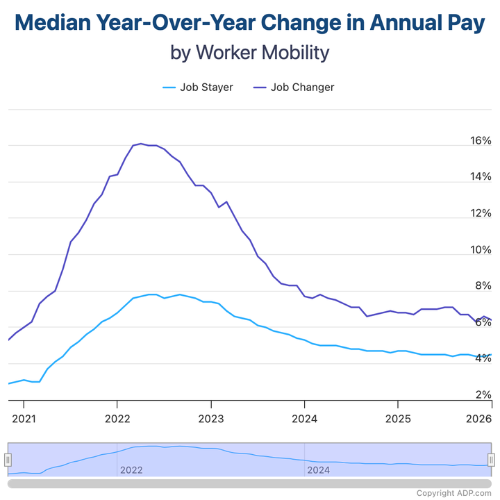
ADP tracks wage growth for employees who stay in their roles versus those who change jobs.
The pattern is clear.
People who change jobs tend to earn more than those who stay.
This is not a call to panic or to quit your job tomorrow.
It is a call to understand something many professionals overlook.
Pay Compression Explained
Have you heard the term pay compression?
DCI Consulting defines it this way:
Pay compression refers to when the earnings of new hires are close to the earnings of current employees in the same job, who may have the same or even more experience.
This happens when someone remains in a role for years, receiving annual merit increases of 2–3%.
Meanwhile:
Job changers are currently seeing average increases of ~6%
Many of my clients see increases between 10–30% when they make strategic moves
Pay compression is not about loyalty.
It is about math.
Knowing Your Worth Is Career Ownership
In Own Your Career, I dedicate multiple sections to the concept of knowing your worth.
Knowing your worth means:
Understanding your external market value
Tracking your measurable impact
Evaluating whether your compensation aligns with your contribution
This is not about ego.
It’s all about informed decision-making.
Why This Matters More Than Headlines
In a slowing job market, the risk is not always job loss.
Sometimes the bigger risk is staying put without understanding your market value.
When hiring slows, companies do not always adjust internal compensation. They do, however, adjust offers for hard-to-fill roles or external candidates.
That is how pay gaps slowly and quietly widen.
What This Means for Your Career
This is not a call to action to leave your job.
It is a call to be informed.
Know your market value
Understand how your compensation compares externally
Evaluate whether your role still aligns with your goals, growth, and earning potential
Career ownership does not require urgency.
It requires awareness.
If you want help evaluating where you stand, pressure testing your options, or thinking through your next strategic move, my virtual Zoom door is open.
Let’s break down your situation, identify what actually matters right now, and take intentional steps forward.
Book your free career strategy session.
Frequently Asked Questions About Pay Compression and the Job Market
Should I change jobs just to earn more?
Not necessarily. A strategic move is different from an impulsive one. Evaluate growth, learning, leadership exposure, and compensation together. Make a thoughtful and informed decision about what is next for you and your career.
How do I know if I am experiencing pay compression?
If you have been in your current role, without a promotion or significant pay increase in 3 - 5 years, you could be experiencing pay compression. Compare your compensation to current market data for your role, geography, and level. If new hires are earning close to or more than you with similar experience, compression may be occurring.
Can I fix pay compression internally?
Sometimes. This may require a promotion, a role redesign, an expanded scope, an ask for a pay equity adjustment, or salary negotiation, supported by documented impact and outcomes.
Is staying loyal risky to my career?
Loyalty to your employer is not inherently risky. Staying uninformed about your career circumstances is.
