How to Write a Job Posting That Attracts Your Ideal Candidate

Your job description may be a wish list. Your job posting is an invitation.
In my first career in Corporate America, I hired customer support professionals for large national call centers.
This was high-volume hiring. We needed people who could communicate well, solve problems, learn quickly, and represent the company during hundreds of customer interactions. Finding the right people wasn’t an occasional part of my job. It was essential to the success of the operation.
Today, as a master professional career coach and résumé writer, I experience the hiring process from the other side. I help experienced professionals evaluate opportunities, communicate their value, and decide whether a role and an organization are right for them.
That combination gives me an interesting view of job postings.
I understand what hiring managers need to know. I also see what candidates notice, question, and interpret when they read how an opportunity is presented.
And if you’re a hiring manager, HR or talent acquisition specialist, or recruiter, I want you to consider this:
Your job posting isn’t only describing an opening. It is introducing candidates to your organization.
Most postings focus almost entirely on what the organization wants. Every so often, I find one that also considers what candidates need.
These postings explain what to expect from the hiring process. They encourage capable professionals who may not meet every preferred qualification. They communicate how the organization approaches new technology. Most importantly, they help the right candidates picture themselves working there.
I recently found some examples that I loved…the receipts are in this article.
A Job Description and a Job Posting Have Different Purposes
Hiring managers and HR professionals may use the terms interchangeably, but a job description and a job posting have different audiences and different jobs to do.
A job description defines the position. It documents the responsibilities, qualifications, reporting relationships, and expectations associated with the role.
A job posting is external communication. Dare I say it? It is a marketing piece.
It needs to reach, engage, attract, and inform the person you hope will fill the role.
Organizations routinely tell candidates to tailor their résumés to a specific opportunity. Yet too many organizations publish an internal job description without adapting it for an external audience and expect it to attract the right people.
Candidates can tell the difference.
Your ideal candidate isn’t only evaluating the responsibilities. They are reading between the lines and forming an impression of your organization.
They want to know:
Does this organization communicate openly?
Will it respect my time?
Can I understand what the hiring process may look like?
Does this company value people whose careers have taken a less traditional path?
Will I be expected to use AI, and may I use it during the application process?
Can I picture myself succeeding here?
The language in your job posting begins answering those questions before a candidate ever speaks with a recruiter or hiring manager.
Give Candidates Useful Information About Timing
Applying for a job requires an investment of time and energy. Candidates research the organization, tailor their materials, answer application questions, and then wait without knowing when the organization may begin reviewing submissions.
A job posting can’t eliminate every uncertainty in the hiring process. It can give candidates meaningful information about what to expect.
Some organizations publish a general application window.

This example tells candidates that the application window is expected to remain open for 100 days. However, it also says the posting could close before or after that point based on business needs.
The organization has provided information, but the candidate still doesn’t know when applications will begin receiving attention or how quickly they should act.
Compare that with a posting that identifies a priority-consideration date.
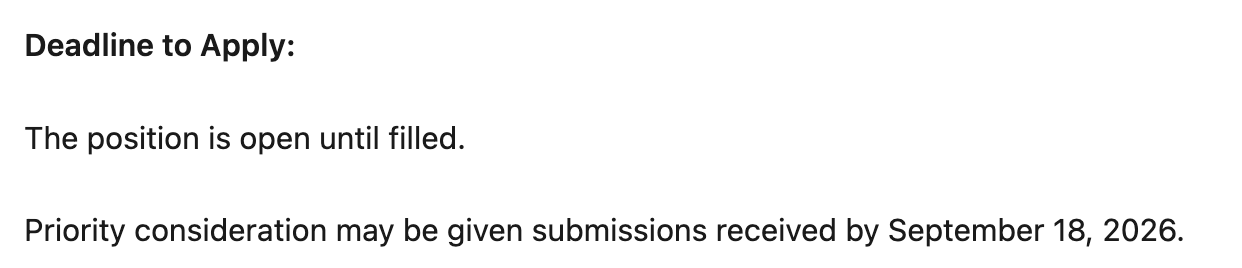
“Open until filled” gives the organization flexibility. The specific priority date gives the candidate something actionable and known.
It doesn’t promise that interviews will begin immediately or that every candidate will receive a response by a certain date. It does help applicants understand when the first review may occur and whether submitting by a particular date matters.
That is the difference between publishing a timeline and setting a useful expectation.
When possible, tell candidates:
When applications will begin receiving consideration
Whether the organization is reviewing applications as they arrive
When the posting is expected to close
Whether the timeline could change
What candidates should expect after applying
You may not be able to provide a precise date for every stage. You can still reduce unnecessary uncertainty.
Tell Candidates How Your Organization Works With AI
Candidates are already using AI to research organizations, interpret job postings, strengthen their résumés, prepare for interviews, and think through how to communicate their experience.
Many employers are also using AI throughout recruiting and hiring.
Yet candidates are frequently left to guess where an organization draws the line.
1Password addresses the issue directly.
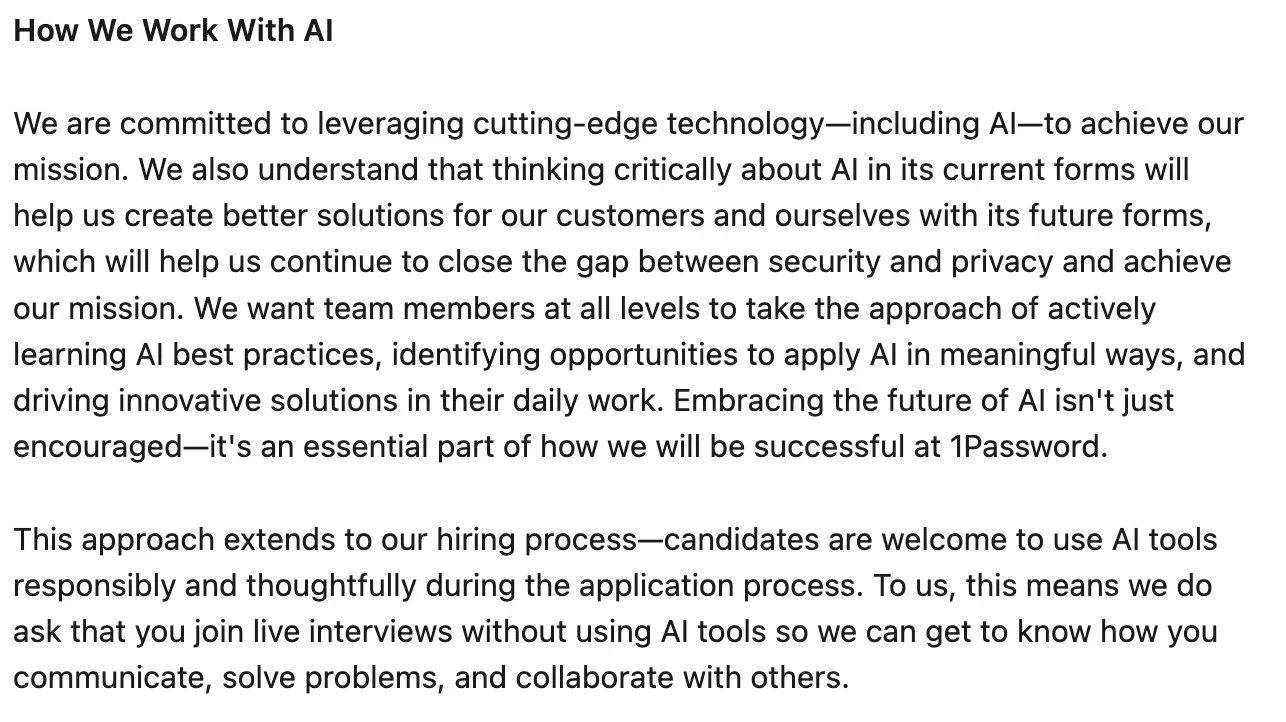
This statement does more than announce that the organization uses AI. It explains the role AI plays in its work, the learning expected from employees, and the boundaries candidates should observe during the hiring process.
Candidates are welcome to use AI responsibly and thoughtfully while applying. During live interviews, however, the organization wants to understand how the candidate communicates, solves problems, and collaborates without AI assistance.
That distinction is so valuable.
It tells candidates what is permitted without treating every use of AI as dishonest. It also explains why the live-interview boundary exists.
If AI is part of your workplace, your hiring communication should address questions such as:
How does your organization expect employees to use AI?
May candidates use AI when preparing application materials?
Are there stages of the interview process when AI may not be used?
Which capabilities must candidates demonstrate independently?
How will you evaluate responsible AI use?
The technology isn’t the only issue candidates are evaluating. They are also looking for evidence that your organization has thought carefully about how people should work with it.
Debunk the Perfect Match Myth
A list of qualifications can quickly become a reason not to apply.
Experienced professionals often understand that a job description represents the organization’s ideal combination of skills and experience. Even so, many capable candidates will count themselves out when they don’t match every item.
Inclusive language can interrupt that reaction, but there are meaningful differences in how organizations extend the invitation.
ABB begins with a broad statement welcoming different kinds of minds, backgrounds, and experiences.

The message is warm and positive. It signals that the organization values difference.
But compare a general statement of welcome with language that directly addresses the decision a candidate is trying to make.

Rockwell Automation acknowledges that a candidate’s experience may not align perfectly with every qualification and explicitly encourages that person to apply.
That doesn’t lower the organization’s standards. It reminds candidates that hiring decisions are based on the complete person, not only on whether every line of a posting matches their background.
Stripe takes that invitation even further.
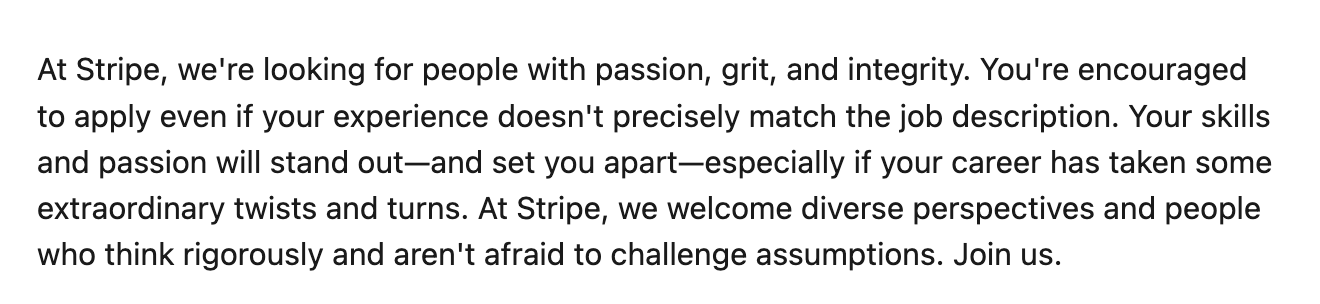
Stripe identifies the qualities it values: passion, grit, integrity, diverse perspectives, rigorous thinking, and a willingness to challenge assumptions.
It also tells candidates that an unconventional career path may help them stand out.
That is especially meaningful to experienced professionals whose careers may include pivots, caregiving responsibilities, industry changes, lateral moves, layoffs, entrepreneurial work, or responsibilities that don’t fit neatly into a traditional progression.
Instead of asking candidates to overlook the differences between their background and the job description, Stripe gives those differences potential value.
Inclusive Language Should Influence a Decision
Inclusive hiring language is most useful when it helps someone decide whether to take the next step.
“We welcome people from all backgrounds” communicates a positive intention.
“Apply even if your experience doesn’t align perfectly” addresses a candidate’s concern.
“Your career twists and turns may set you apart” helps the candidate reconsider what they once viewed as a disadvantage.
Each statement moves closer to the person reading the posting.
Before adding a standard inclusion paragraph, ask:
What might cause a qualified person to count themselves out?
Which qualifications are genuinely required on the first day?
Which capabilities can be learned after hiring?
Are preferred qualifications written as though they are mandatory?
Does the posting leave room for transferable experience?
Can candidates understand which qualities matter beyond a checklist?
You don’t need to persuade everyone to apply. You need to help the right people accurately recognize the opportunity.
Communicate More Than The Role’s Responsibilities
A job posting can show candidates that your organization has considered their experience. It can set expectations, explain boundaries, reduce unnecessary guesswork, and encourage capable people to enter the process.
Before publishing your next opening, don’t only ask whether the posting accurately describes the job.
Ask whether it speaks to the person you hope will see themselves in it.
Your organization may be evaluating candidates, but candidates are equally evaluating your organization from the first sentence.
The strongest job postings remember that communication goes both ways. Your relationship with a potential employee begins with the job posting, long before the first interview.
If you’re a job seeker, what language have you seen in a posting that made an organization stand out? What helped you feel informed, welcomed, or encouraged to apply? I’d love to see your favorite examples, share them below.
And if you’re a hiring manager, recruiter, or HR or talent acquisition professional who wants to improve the messages candidates and employees receive, I help organizations strengthen job-posting language, onboarding materials, and professional-development programs. Contact me to begin the conversation.
